
About Us
We founded Clean Energy Greenhouses, SPC, a for-profit social-purpose corporation, with a clear vision: to empower small family farms through innovation and sustainable agriculture. As an SPC, we're a for-profit company free to pursue social and environmental goals alongside shareholder value, rather than being bound to focus almost entirely on the bottom line.
Our journey began in 2017, driven by a commitment to help address the pressures reshaping modern farming, including climate-induced water shortages, shrinking arable land, the resulting food insecurity, and agriculture's own environmental footprint. We built and tested prototype solar-powered greenhouses and continued to experiment. Progress slowed during the pandemic, but the problems we set out to help solve only intensified.
Today, by commercializing our work, Clean Energy Greenhouses plans to contribute to Climate-Smart Agriculture by focusing on Controlled Environment Agriculture (CEA), that is, growing in protected, resource-efficient systems like greenhouses. That mission is exactly why our corporate structure matters; in agriculture, long-term sustainability goals can collide with short-term earnings pressure. Our SPC status ensures that our commitment to resource efficiency and small-farm profitability endures, even if leadership changes or our company goes public.
By integrating clean energy greenhouse solutions with aquaponics, vertical hydroponics, permaculture, and automation, we offer one blueprint for the future of farming, a future where productivity and profitability meets stewardship and ecological responsibility.
CEG's 2017 Prototype
Parabolic frame construction


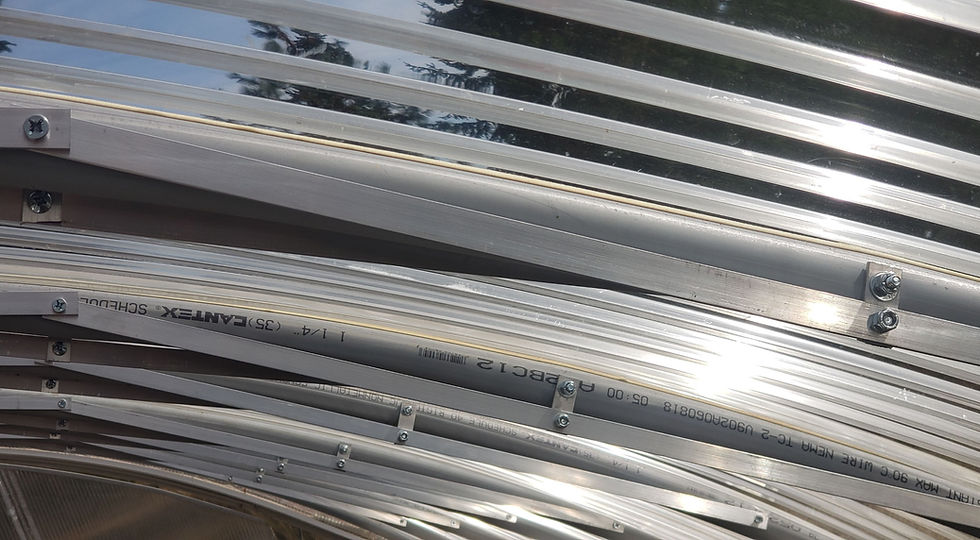
The parabola is exceptionally strong because it uniformly distributes weight and directs compressive forces outward and downward, allowing it to support heavy loads without relying on heavy internal supports.
Deep-snow load strength is achieved with inexpensive aluminum reinforcement struts (left). Weight is further accommodated by expansion/contraction joints (far left)
The parabolic curve forms naturally, so no prefab or bending is needed.
Total cost: $34 per spine compared to 1” OD steel @ $97.60 per spine, excluding pre-forming cost.
Thermal battery construction

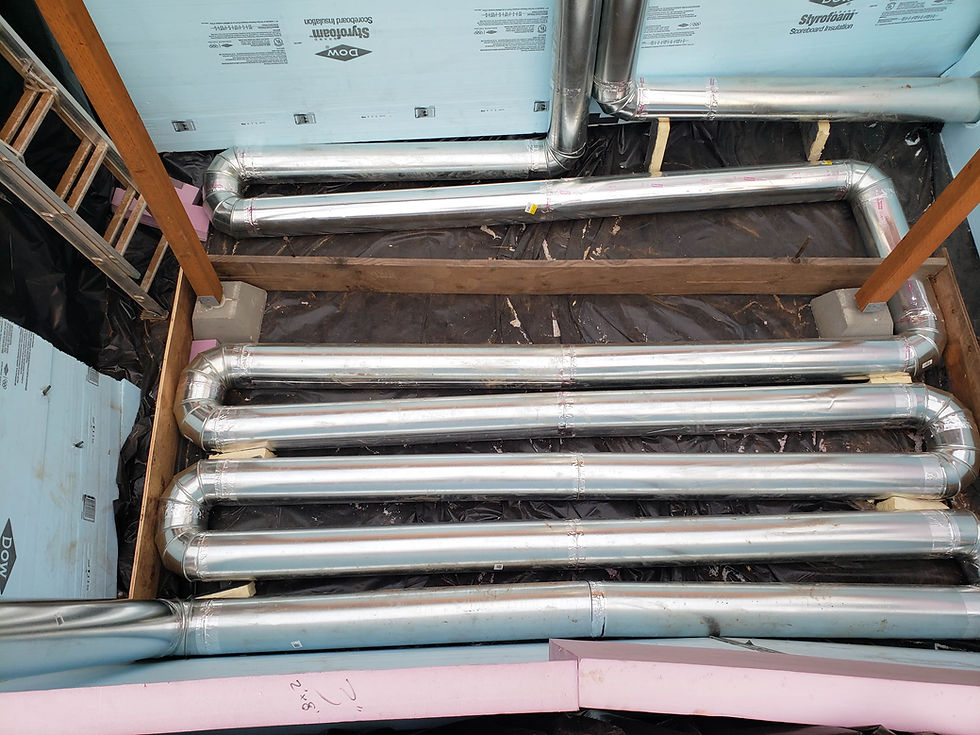

A concrete slab was poured over galvanized ducting tubes at the bottom of the 10" x 12' x 9' deep excavation. The slab was then buried with gravel to form a thermal mass.
Large fans force air from the greenhouse ceiling through the tubes and then directed back into the greenhouse via vents at ground level. This helps cool the greenhouse in the summer and warm it during the winter


A concrete slab was poured over galvanized ducting tubes at the bottom of the 10" x 12' x 9' deep excavation. The slab was then buried with gravel to form a thermal mass.
Large fans force air from the greenhouse ceiling through the tubes and then directed back into the greenhouse via vents at ground level. This helps cool the greenhouse in the summer and warm it during the winter
A concrete slab was poured over galvanized ducting tubes at the bottom of the 10" x 12' x 9' deep excavation. The slab was then buried with gravel to form a thermal mass.
Large fans force air from the greenhouse ceiling through the tubes and then directed back into the greenhouse via vents at ground level. This helps cool the greenhouse in the summer and warm it during the winter
550 gallon fish tank construction
Hydroponics


Digital thermostats automatically turn on fans that intake cooler outside-air and exhaust inside heat when the temperature exceeds 78F.
If the ceiling temperature rises above 90F, misters automatically turn on, and the fans, work as evaporative coolers.
The air temperture drops below 78F in about 7 minutes, and misters and fans turn off.
Evaporative Cooling
Completed solar-powered greenhouse


